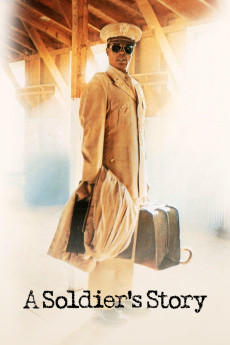
A Soldier's Story

1984

Action / Crime / Drama / Mystery / War
24
Rotten Tomatoes Critics - Certified Fresh 91% · 23 reviews
Rotten Tomatoes Audience - Upright 82% · 5K ratings
IMDb Rating 7.2/10 10 12424 12.4K

Director

Top cast

Robert Townsend as Corporal Ellis
Denzel Washington as Private First Class Peterson
William Allen Young as Private Henson
Patti LaBelle as Big Mary
720p.BLU 1080p.BLU
926.88 MB
1280*694
English 2.0
NR
23.976 fps
1 hr 40 min
Seeds 6
1.68 GB
1920*1040
English 2.0
NR
23.976 fps
1 hr 40 min
Seeds 19

Movie Reviews

Reviewed by ElMaruecan82 7 / 10

Who shot Sergeant Waters?

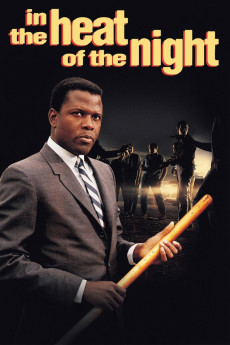
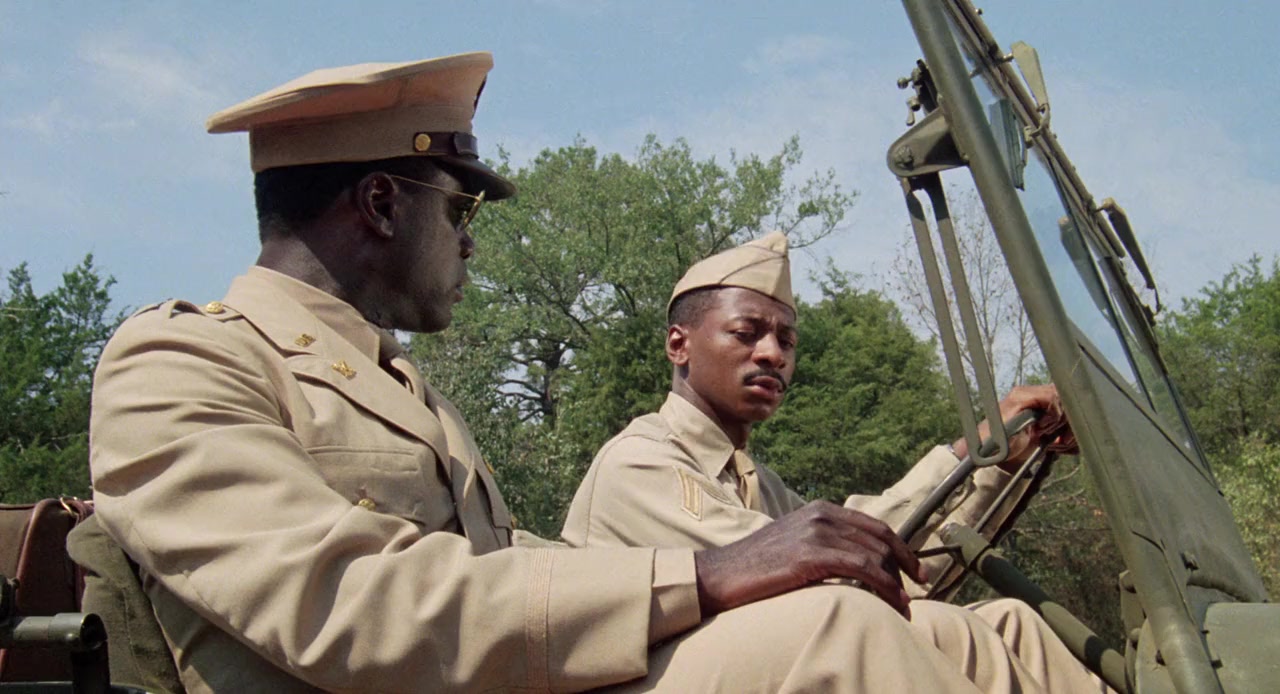
Norman Jewinson's 1967 "In the Heat of the Night" delved into racial prejudices through the unlikely partnership between a White Southern cop (Rod Steiger) and a Black officer played by Sidney Poitier. His name was Virgil Tibbs and his non-welcomed involvement in a murder investigation revealed interesting facets of his personality not entirely devoid of prejudices. The Best Picture winner spoke many powerful statements about racism, while sticking to the basic formula of a mystery thriller, it wasn't just groundbreaking but entertaining.I needed to start with a long preamble to assert that Jewison's "A Soldier's Story" certainly carries the same noble intentions but never really manages to elevate itself to the level of its glorious predecessor. The film grabs the viewer's attention thanks to the wonderful characterization of a complex character named Sergeant Waters, played by Adolph Caesar, some stand-out performances from Harold E. Rollins Jr. and a young and promising Denzel Washington, not to mention a well-written screenplay from Pullitzer-winning playwright Charles Fuller (he adapted his own play to the big screen) but there's a problem with the film: it forgot to be one.We gather that the whole 'whodunit' structure is only an excuse for a character study, but the latter succeeds at the expenses of the former. That's the trick with play adaptations, dialogue is the raw material so they end up loaded with insights that confine to stage lecturing without that emotional kick only the big screen can provide. "A Soldier's Story" reveals some disturbing truths about Black soldiers' mindset in the segregated South and the way self-hatred inhabits the hearts of those torn between duty and their feeling of a tacit oppression but there's never anything crucial at stakes. Even Reginald Rose's play "12 Angry Men" had the life of the accused boy pending on the jury.But in "A Solider's Story", Waters is dead already. Sure we want to know the truth about his killer, but in fact the real mystery is the victim himself. And Waters is quite a character, I never knew whether to be in awe of or despise him. When we first meet him, he's drowning his sorrow in a Louisiana jazz club, his state of total inebriation betrays a visceral admission of failure, such an overwhelming one that his death was the closest thing to a deliverance; hence his last burst of nerve when he's being beaten later. He's got the time to shout "they still hate you" and laugh manically before a .45 automatic bullet finally silences him. Naturally, we don't know who shot him but the Klan suspicion is way too obvious to fool us. From the start I suspected the killer would be one of his own soldiers and the film one of these stories where everyone has a motive.Captain Davenport, lawyer by training, is assigned to lead the investigation and he's got three days to conduct the mission; he's played by the late Rollins. He's commanding and charismatic with his shady sunglasses that convey the same mix of threat and dignity as Colonel Mathieu in "Battle of Algiers". His presence inspires the respect and admiration of other Black soldiers and the bafflement of White officers, when it's not sheer disdain, as demonstrated by Colonel Taylor (Dennis Lipscomb). Rollins is the implacable force that confidently drives the plot, the Virgil Tibbs I would say. And his method is straight-to-the-point, investigating the case by interrogating different soldiers who were under Waters' iron-handed commandment.First there's Private Wilkie, a disgraced former sergeant played by Art Evans. Then C.G. Memphis (Larry Riley) as the Southern gentle fellow who only inspired Waters' disgust, reminding him of the 'yes boss' sellouts of his youth. And there's First Class Petterson, Washington as the rebel who had the guts to stand against Waters and fought him with bare fists. As the flashbacks reveal the tormented relationships Waters had with his troop, we see the ramifications sneaking toward an unfamiliar territory. The "black vs. white" canvas vanishes, unveiling the very demons that inhabited Black people in a context where race still mattered. And for that I command the script and the play by Fuller, and the performances too.But I also sympathize with Ebert's statement about the rather loose mystery structure, the film waits for the right moments to reveal the clues while in "In Heat of the Night", the narrative was linear and we were never one step behind the protagonists. To put it simply: there's a suicide that is never mentioned until there's twenty minutes left before the ending and a precious information about the weapons could have accelerated the whole investigation. Of course, we had to get through all these testimonies for the sake of the "message" but just because a film has powerful things to share with the viewers doesn't mean they should have a convenient timing as if they were following plot requirements more than sheer logic.I wish I wouldn't have to point out these technicalities because the film deserved better. And so did Caesar who was simply outstanding with his intimidating tone that only a few facial tics could contradict, showing how full of petty resentment he was. Sure he could pretend to be big despite being towered by each soldier (wasn't he after all the one who made Danny Glover look like a pathetic Daddy's boy in "The Color Purple"?) but Waters is the kind of characters that are so well-written and complex that they end up revealing the complexities of the others. He's the spine of the film, inspiring that quote at the very end (I'm paraphrasing) "who gives you the right to tell you who's the right or wrong Black person" from a tearful Davenport.But that's the kind of grand ending that needed a film of higher caliber. Interestingly, I thought the same of its Best Picture co-nominee "Places in the Heart", too wrapped up in its noble intentions that it couldn't transcend them.
Reviewed by

Reviewed by sol1218 8 / 10

Some things need getting rid of!

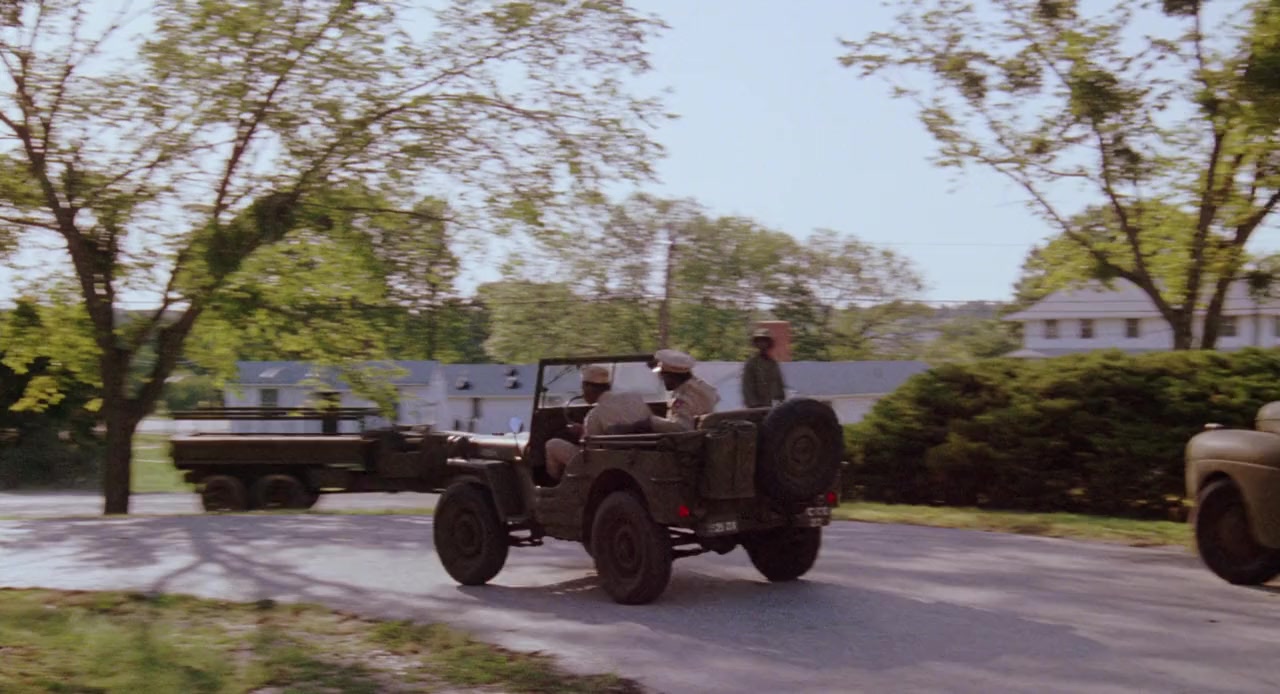
***SPOILER ALERT*** Drinking himself into a drunken stupor US Army Sgt. Waters, Adolph Caesar, staggered out of Big Mary's Place and was later found by the Tynin Bridge beaten and shot to death.

With Sgt. Waters being black it was immediately suspected that he was murdered by either members of the KKK or local townspeople who, in the deep south in 1944, didn't take too kindly in blacks, even servicemen, being in their town. There was also the fear that the black soldiers, from an all black army garrison, stationed outside of Tynin would take matters in their own hands in revenge of their fellow black Sgt. Waters being murdered by, as suspected, some of Tynin's racist citizens.

Sending a US Army black officer to investigate the Waters murder was thought, by the Pentagon, to be the best way to defuse this very dangerous and explosive situation. As things turned out it was, the Waters murder, far more shocking as well as racist then anyone could have imagined! With the racism being instigated my the murder victim himself the late Sgt. Waters!

Powerhouse movie that has black US Army Captain Davenport, Howard E. Rolins Jr, go against type in what his white superior officers expected him to do, white wash his investigation, and get to the meat of the matter in Sgt. Waters' murder. As he uncovered the circumstance's that lead to Waters murder Capt. Davenport became to realize that it was his actions towards the black troops that he commanded, not that of local white racists, that lead to his ignoble demise.

As Capt. Davenport found out there was very bitter hatred towards the black troops stationed outside of Tynin but it was Sgt. Waters own racism, towards some of his men, that eventually lead to his murder. Being a spit & polish as well as educated career man Sgt. Waters look down on some his fellow blacks in them dragging top notch soldiers like himself down.

****SPOILERS FROM THIS POINT ON*** Using his #1 suck up Pvt. Wilkie, Art Evens, to do his dirty work Sgt. Waters framed Pvt.C.J Memphis, Larry Riley, in a triple murder on the army base. Knowing that the charge wouldn't stick, were not even sure if anyone was murdered in the first place, Waters then getting C.J to take a swing at him, knocking Waters flat on his butt, was a charge-striking a superior officer-which did.

With the good natured C.J now locked up in the stockade a vengeful and sadistic Waters paid him a visit telling C.J that he's to do at least five years for belting him. This lead to a despondent and terrified, in being behind bars, C.J into hanging himself the following evening! It was the unexpected suicide of C.J that lead Sgt. Waters to go on a drinking binge that lead to him ending up murdered! The big question in Capt. Davenport's mind is who among the black troops on the base murdered him!

More then anything else the movie "A Soldier's Story" shows that racism comes in all shapes sizes as well as colors. The bitter racism that Sgt. Waters had for poor C.J Memphis was far more vicious then the racism that the local whites had for him or any other black for that matter. Just because C.J was good natured and didn't have a chip on his shoulder like the infuriated Sgt. Waters did lead to Waters framing him for a number of murders that C.J didn't commit. The chip that Sgt. Waters carried all his adult life was that he couldn't accept the fact that he was black and thus put down by the society that he grew up in. And it was that sick and dangerous distortion of reality that lead not only to Sgt. Waters feelings of insecurity but the racism that he developed over the years against his own, like in the case of C.J Memphis, people! And in the end it was Sgt. Waters' own men whom he commanded that made him pay for it!

Read more IMDb reviews

1 Comment

Be the first to leave a comment