In the Land of the Head Hunters

1914

Drama / History

4
IMDb Rating 5.8/10 10 593 593

Top cast

Awidi as Extra
Francine Hunt as Clam digger
Bob Wilson as Fisherman who drops a paddle on the rocks
Kwagwanu as Sorcerer
720p.BLU 1080p.BLU
611.24 MB
1280*720
English 2.0
NR
23.976 fps
1 hr 6 min
Seeds 1
1.23 GB
1920*1080
English 5.1
NR
23.976 fps
1 hr 6 min
Seeds 5

Movie Reviews

Reviewed by roedyg 5 / 10

a look into an alien world

Land of the War Canoes is a black and white silent film remastered in 1973. Mainly they added a sound track. All the dialogue is in Kwakiutl without subtitles. The film is in terrible shape. It needs modern day digital retouching to fix the wildly fluctuating exposure levels and age damage.It is a surprisingly long film. The plot is two tribes warring over a female. It has sorcery, head hunting, whale hunting, many tipped canoes.The best parts are the athletic dancers in clever costumes to mimic various birds, animals and insects.Everybody looks the same, so it hard to keep track of who is fighting whom.The main value of the film is how alien it is. None of the attitudes, dress, food, customs... is familiar. The beauty of the film comes from the many elegant war canoes.
Reviewed by boblipton 7 / 10

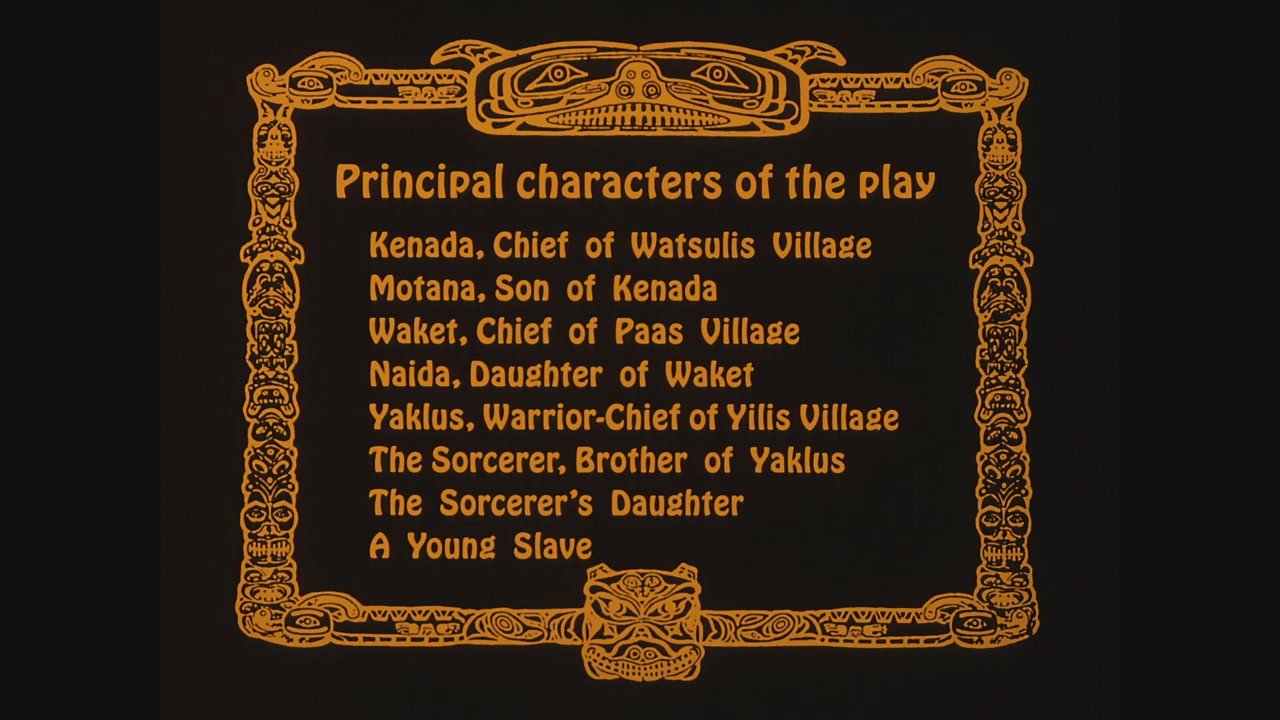
"The plotters, anticipating Motana's death, "mourn" him as his hair, stuffed into the bodies of toads, smokes over their fire" reads one of the title cards. This is, after all, a documentary about the Kwakiutl Indians. And yet, clearly, it is a directed story film. It's an unusual sort of film these days, limited to "novel and astonishing works of unprefigured genius" like THE GODS MUST BE CRAZY, but in reality, this is how documentaries started. Flaherty "cheated" by modern standards on NANOOK OF THE NORTH. CHANG has a story line imposed on it. While unedited footage of Kwakiutl Indians carving totem poles might have been a big draw in 1896, by 1914 the sophisticated filmgoer demanded more: a story line. And so we had this, by modern standard, odd .... well, call it a "mockumentary", but not in the sense of a Christopher Guest film. We see real Kwakiutls in real Kwakiutl regalia dancing real Kwakiutl war dances aboard real Kwakiutl war canoes. It's just that it's edited together and given titles to make it a story. Interestingly, although a story film, this movie survives because it was saved at a couple of museums. So what can we make of it?Well, make of it what you want. A feature film from the dawn of feature films; fascinating shots of Kwakiutl Indians when they still did these things. Do you want egg in your beer?
Reviewed by alisonc-1 6 / 10

As Historical Document, Valuable; As Film, So-So

Okay, first off, check the date - "In the Land of the Head Hunters" is a reconstructed and remastered print of a film made in 1914, by Edward S. Curtis, known mostly now as a photographer and ethnographer. As such, it is entirely of its time - i.e., racist, sexist and certainly specious in its depiction of a First Nations people. But valuable for all of that. The story line, for what it's worth, concerns a young son of a tribal chief who does his manhood rituals, falls in love and marries the daughter of another tribe's chieftain; this upsets the Sorceror, brother of yet another tribal chief who wanted the girl for himself - mayhem ensues, mostly in canoes but also on land, until eventually the good guy prevails. It's simplistic and definitely racist - the people are portrayed as quaintly primitive, the women are completely subservient to the men, and the main occupation of the tribes involves war and cutting off the heads of enemies.Given that this is actually set in the Pacific Northwest, between Washington State, USA, and British Columbia, Canada, the whole head- hunting aspect is completely off. Not to mention the "primitive" label - these peoples were highly sophisticated, just not in a form recognized (at the time) by Europeans. But the positives in this film are quite striking too. First of all, the actors are all actual members of the Kwakwaka'wakw Nation, from Vancouver Island, and the costumes, totem poles and especially the special dances are all authentic. The story, by white director Curtis, is worthless; as a bit of filmed historical information, however, the movie is quite valuable. Many scenes were lost over the past 100 years, and the restorers opted to insert still photographs (also by Curtis, of the same people) to bridge the gaps, which doesn't work all that well dramatically, but is again useful as an historical artifact; they also were able to restore the original orchestral soundtrack, which adds drama to this silent movie. Certainly not for everyone, but film historians and anthropologists might find something of value here.
Read more IMDb reviews

2 Comments

Be the first to leave a comment