Nine Men

1943

Action / Drama / War

2
Rotten Tomatoes Audience - Upright 80%
IMDb Rating 6.3/10 10 362 362

Director

Top cast

Gordon Jackson as The Young 'un
Fred Griffiths as Base Sergeant
Jack Horsman as Joe Harvey
Giulio Finzi as Italian Mechanic
720p.WEB 1080p.WEB
616.53 MB
968*720
English 2.0
NR
us  gr  es  hu  ro  
24 fps
1 hr 7 min
Seeds ...
1.12 GB
1440*1072
English 2.0
NR
us  gr  es  hu  ro  
24 fps
1 hr 7 min
Seeds 1

Movie Reviews

Reviewed by GianfrancoSpada 6 / 10

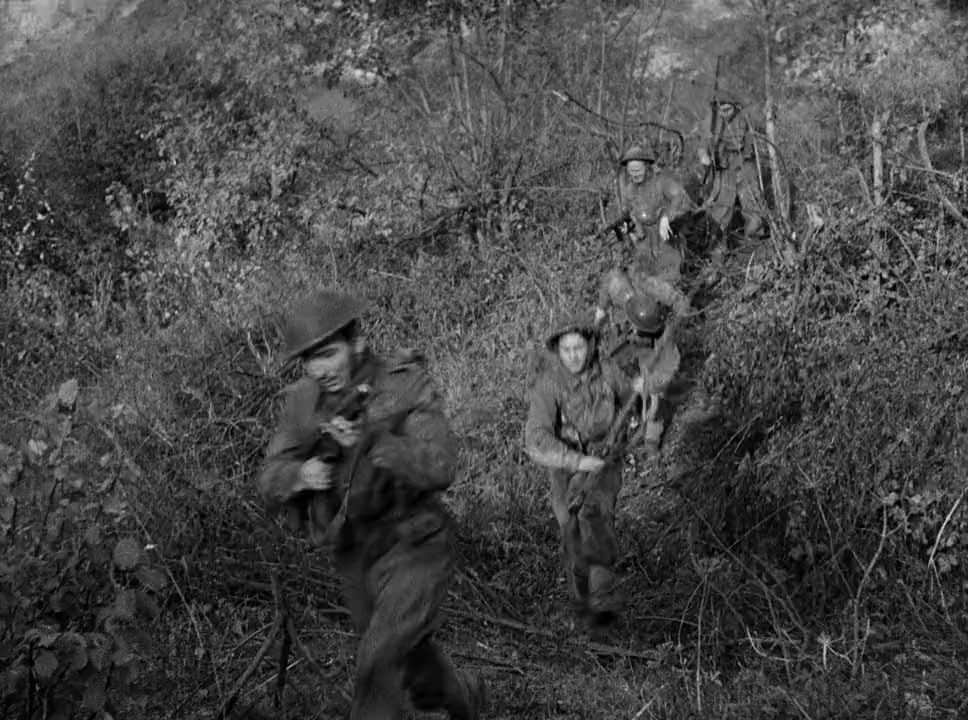
Nine Men at target practice...

It is impossible to approach this film without first acknowledging the unique historical moment of its production. Released in 1943, at the height of the Second World War and during a time when the outcome was far from certain, the movie carries an unmistakable urgency that transcends conventional storytelling. Its economy of means-both in terms of budget and location-serves not as a limitation, but rather as an accelerant for a particularly British form of war cinema that privileges endurance, camaraderie, and moral clarity over spectacle. The film does not indulge in triumphalism; rather, it sharpens its focus on the necessity of resolve under pressure, resonating more as an instrument of moral fortification than pure propaganda.Technically, the film demonstrates a remarkable command of spatial dynamics, especially considering the constraints of its set: a single, claustrophobic desert dugout. This choice is not merely a cost-saving measure but becomes a vehicle for exploring psychological tension and social structure under duress. The confined space enhances both dramatic intensity and symbolic weight, turning the dugout into a microcosm of wartime Britain. Cinematography favors stark contrasts and low angles, amplifying the sense of entrapment and the vulnerability of the men under siege. The interplay of light and shadow within this cramped environment is handled with an expressive precision that belies the film's modest origins, effectively mirroring the mental state of the characters and the bleak, shifting nature of desert warfare.Performance-wise, the ensemble avoids overt dramatics in favor of a disciplined realism. The commanding figure at the center projects a stoic resilience that never shades into theatrical heroism, allowing space for the ensemble to breathe as a collective rather than as a hierarchy of stars. This approach reinforces the narrative's focus on unity and shared burden rather than individual glory. The absence of over-embellished pathos is particularly striking; instead, emotion emerges from the actors' physicality-their posture, their terse exchanges, their silences. The soldierly demeanor is captured not through speeches but through an accumulation of minute gestures, terse routines, and the exhaustion etched into their movements.Stylistically, the film bears some affinity with Sahara (1943), yet where the American film opts for a more expansive, almost allegorical vision of wartime cooperation, this British production remains intimate, grounded, and stripped of romanticism. The antagonism is more starkly racialized in Sahara, aligning with its American wartime ethos, while this movie, despite its colonial setting, avoids any elaborate engagement with the enemy's psychology-portraying them as a faceless, ever-encroaching threat, which suits the film's parable-like structure and its interest in endurance over confrontation. The moral center of the film is not about defeating the enemy, but about holding together in the face of pressure.In comparison to The Way Ahead (1944), which dramatizes the transformation of British civilians into soldiers and reflects a broader pedagogical and mobilizing function, this film occupies a narrower narrative terrain. Yet the restriction is purposeful: it insists on the self-sufficiency of a small unit as a metaphor for the British war effort. Where The Way Ahead leans into a slow build-up and is invested in transformation and instruction, this film is already embedded within crisis. It doesn't teach so much as remind-a cinematic confirmation that the traits already existing within the British character-perseverance, wit, camaraderie-are sufficient when tested.Sound design, though subtle, plays a crucial role in heightening the tension. The distant echo of enemy gunfire, the crunch of sand beneath boots, and the oppressive silence of waiting punctuate the dialogue, creating a psychological geography as important as the physical one. The soundtrack refrains from intrusive orchestration, allowing ambient noise to carry the emotional weight. This choice further anchors the film in realism and sustains the atmosphere of dread and endurance.Editing is crisp, never showy, relying on a deliberate rhythm that mimics both the tension of anticipation and the sudden bursts of chaos that punctuate desert combat. There are no flourishes, no montage sequences meant to condense or dramatize. Every cut serves to reinforce the temporal and spatial continuity of the moment, which deepens immersion and trust in the film's visual logic. The restraint here is both aesthetic and ideological; it insists on a form of filmmaking that does not manipulate, but rather confronts.Yet one cannot overlook the troubling depiction of the enemy, in this case Italian soldiers, who are reduced to caricatures-mere silhouettes of martial incompetence. Their attacks are tactically senseless, often resembling rehearsed charges with no cover or coordination, as though they exist only to be gunned down. They approach the British dugout with an eerie, almost suicidal predictability, like clay targets on a carnival track, there to reinforce the illusion of invincibility. The absurdity of these tactics would be glaring even to an untrained observer, undermining the film's otherwise sober commitment to realism. From a military standpoint, the Italian forces in North Africa-regardless of their material disadvantages-were capable of complex operations and tenacious defense, and to deny them even a semblance of strategy or self-preservation is to empty the confrontation of any real stakes.This reduction of the enemy to little more than comic foils has deeper implications. By staging the war as a kind of grotesque pageant-where the British fire calmly from cover while the Italians stumble forward like puppets detached from the strings of reason-the film transforms combat into something recreational, almost anecdotal. It invites the homefront audience to view the desert campaign not as a grinding, uncertain ordeal, but as a fairground stall, where victory is a question of steady aim and the targets never shoot back effectively. This rhetorical strategy may have served a psychological function in 1943, calming a fatigued and battered population by presenting the enemy as laughably inept. But in doing so, it inadvertently sows the seeds of a narrative problem: if the war was won against such ineffectual adversaries, then what precisely was the moral or military achievement?With time, such portrayals age poorly. They rob the British effort of its hard-earned legitimacy by constructing a hollowed-out adversary, whose defeat demands neither tactical brilliance nor courage, but simply the patience to wait for the next wave of idiots to appear in the crosshairs. It is a narrative shortcut that, while understandable in the fog of wartime messaging, ultimately diminishes the very valor it seeks to exalt. The courage of British soldiers in North Africa-and their Italian counterparts, often conscripted and poorly equipped yet still committed to their duty-deserves a portrayal that acknowledges the gravity and mutual suffering of the battlefield.What distinguishes this film within its subgenre-desert-based small-unit survival dramas-is its tonal discipline. There is no sentimentality, no redemptive arc, and very little exposition. It resists not only the lure of spectacle but also the ease of binary moralizing. This absence of flourish might be misread by contemporary viewers as a lack of ambition, but in the context of 1943 Britain, such restraint carried its own form of ideological potency. The war was not a narrative with an assured resolution; it was an unfolding, grinding ordeal. The film reflects that, not by providing catharsis, but by enacting the emotional rhythms of collective persistence. Yet in its portrayal of the enemy, it trades nuance for reassurance, and in doing so, it curiously weakens the very drama it so expertly stages.
Reviewed by

Reviewed by JoeytheBrit 6 / 10

Nine Men review

Jack Lambert and his troop of soldiers stumble across a giant sandcastle in the Port Talbot desert after they become separated from their convoy, and find themselves under attack from cheese-eating, wine-swilling 'eyeties'. Their ordeal is only marginally worse than that endured by the audience that must sit through Lambert's terrible acting as he fills his lads in on the meaning of 'umbitty-poo'. Luckily, the plot is just about strong enough to overcome his performance.

Read more IMDb reviews

No comments yet

Be the first to leave a comment